













-
Suffering For Science: Reason and Sacrifice in Modern America
Rebecca M. Herzig
From gruesome self-experimentation to exhausting theoretical calculations, stories abound of scientists willfully surrendering health, well-being, and personal interests for the sake of their work. What accounts for the prevalence of this coupling of knowledge and pain-and for the peculiar assumption that science requires such suffering? In this lucid and absorbing history, Rebecca M. Herzig explores the rise of an ethic of "self-sacrifice" in American science. Delving into some of the more bewildering practices of the Gilded Age and the Progressive Era, she describes when and how science-the supposed standard of all things judicious and disinterested-came to rely on an enthralled investigator willing to embrace toil, danger, and even lethal dismemberment. With attention to shifting racial, sexual, and transnational politics, Herzig examines the suffering scientist as a way to understand the rapid transformation of American life between the Civil War and World War I.
Suffering for Science reveals more than the passion evident in many scientific vocations; it also illuminates a nation's changing understandings of the purposes of suffering, the limits of reason, and the nature of freedom in the aftermath of slavery. -
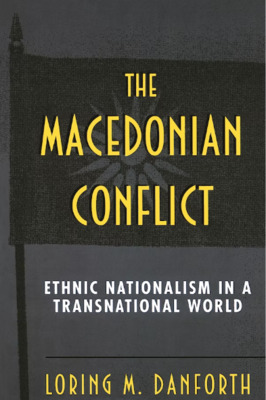
The Macedonian Conflict: Ethnic Nationalism in a Transnational World
Loring M. Danforth
Greeks and Macedonians are presently engaged in an often heated dispute involving competing claims to a single identity. Each group asserts that they, and they alone, have the right to identify themselves as Macedonians. The Greek government denies the existence of a Macedonian nation and insists that all Macedonians are Greeks, while Macedonians vehemently assert their existence as a unique people. Here Loring Danforth examines the Macedonian conflict in light of contemporary theoretical work on ethnic nationalism, the construction of national identities and cultures, the invention of tradition, and the role of the state in the process of building a nation. The conflict is set in the broader context of Balkan history and in the more narrow context of the recent disintegration of Yugoslavia.
Danforth focuses on the transnational dimension of the “global cultural war” taking place between Greeks and Macedonians both in the Balkans and in the diaspora. He analyzes two issues in particular: the struggle for human rights of the Macedonian minority in northern Greece and the campaign for international recognition of the newly independent Republic of Macedonia. The book concludes with a detailed analysis of the construction of identity at an individual level among immigrants from northern Greece who have settled in Australia, where multiculturalism is an official policy. People from the same villages, members of the same families, living in the northern suburbs of Melbourne have adopted different national identities. -
Worlds within Worlds: The Novels of Ivan Turgenev
Jane Costlow
The novelist Ivan Turgenev (1818-1883) is known primarily as a chronicler of his age and crafter of elegant prose--like the simplest painting of daily artifacts, his works have pleased partly because they shape a recognizable world and partly because their form gives to the content its resonant signifying power. Here Jane Costlow accounts for both the historicity and aesthetic elegance of Turgenev's realist novels in close readings of Rudin, A Nest of Gentry, On the Eve, and Fathers and Children, all written between 1855 and 1861. Each essay focuses on a particular aspect of Turgenev's art as it relates to his human and aesthetic concerns. This study challenges traditional views of Turgenev as an objective recorder of his times, suggesting that the engaging qualities of his novels lie less in their historicity than in the lyricism and aesthetic consciousness with which he shaped his narratives. Costlow explores the lyric meditation, pastoral longing, and unspoken emotion that are the hallmarks of Turgenev's prose and that make up his "worlds within worlds," the realms of his novels that elude the historical. Throughout she demonstrates how the aesthetics of constraint and understatement mask the author's awareness of limitation and complexity in human experience. By stressing the enigmatic and challenging qualities of his works, Costlow exposes Turgenev to revealing new readings.
-
Firewalking and Religious Healing: The Anastenaria of Greece and the American Firewalking Movement
Loring M. Danforth
"If the Saint calls you, if you have an open road, then you don’t feel the fire as if it were your enemy,” says one of the participants in the Anastenaria. This compelling work evokes and contrasts two forms of firewalking and religious healing: first, the Anastenaria, a northern Greek ritual in which people who are possessed by Saint Constantine dance dramatically over red-hot coals, and, second, American firewalking, one of the more spectacular activities of New Age psychology. Loring Danforth not only analyzes these rituals in light of the most recent work in medical and symbolic anthropology but also describes in detail the lives of individual firewalkers, involving the reader personally in their experiences: he views ritual therapy as a process of transformation and empowerment through which people are metaphorically moved from a state of illness to a state of health. Danforth shows that the Anastenaria and the songs accompanying it allow people to express and resolve conflict-laden family relationships that may lead to certain kinds of illnesses. He also demonstrates how women use the ritual to gain a sense of power and control over their lives without actually challenging the ideology of male dominance that pervades Greek culture. Comparing the Anastenaria with American firewalking, Danforth includes a gripping account of his own participation in a firewalk in rural Maine. Finally he examines the place of anthropology in a postmodern world in which the boundaries between cultures are becoming increasingly blurred.
-
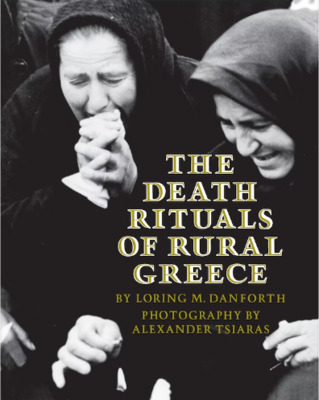
The Death Rituals of Rural Greece
Loring M. Danforth
This compelling text and dramatic photographic essay convey the emotional power of the death rituals of a small Greek village — the funeral, the singing of laments, the distribution of food, the daily visits to the graves, and especially the rite of exhumation. These rituals help Greek villagers face the universal paradox of mourning: how can the living sustain relationships with the dead and at the same time bring them to an end, in order to continue to live meaningfully as members of a community? That is the villagers’ dilemma, and our own. Thirty-one moving photographs (reproduced in duotone to do justice to their great beauty) combine with vivid descriptions of the bereaved women of “Potamia” and with the words of the funeral laments to allow the reader an unusual emotional identification with the people of rural Greece as they struggle to integrate the experience of death into their daily lives.
Loring M. Danforth’s sensitive use of symbolic and structural analysis complements his discussion of the social context in which these rituals occur. He explores important themes in rural Greek life, such as the position of women, patterns of reciprocity and obligation, and the nature of social relations within the family.
Printing is not supported at the primary Gallery Thumbnail page. Please first navigate to a specific Image before printing.